

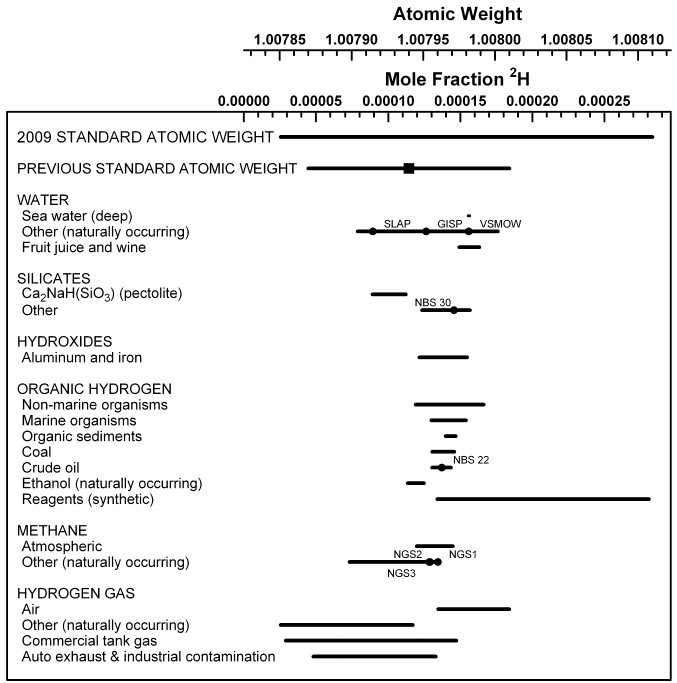
Because the atomic weight of an element varies across the Earth, the atomic weight of the element in a sample can sometimes help identify the origin of the sample. This variability allows climate scientists to estimate historical temperatures and determine carbon sources by measuring differences in isotope ratios between different samples. Observe the graph below, which indicates selected sources of hydrogen that have certain atomic weights and mole fractions of hydrogen-2.
International. March-April 2011, 33.
http://www.iupac.org/publications/ci/2011/3302/2_ coplen.html (accessed July 23, 2012).
Assume you obtain a sample in which the atomic weight of hydrogen atoms in the molecules of the sample is 1.00798. Would this sample most likely have originated from coal, fruit juice or auto exhaust?
In coal, hydrogen atoms contained in the coal molecules have an atomic weight interval from approximately 1.00795 to 1.00797.
In fruit juice, hydrogen atoms contained in the fruit juice molecules have an atomic weight interval from approximately 1.00797 to 1.00799.
In auto exhaust, hydrogen atoms contained in the auto exhaust molecules have an atomic weight interval from approximately 1.00787 to 1.00796.
Therefore, a sample in which the molecules contain hydrogen atoms with an atomic weight of 1.00798 would likely originate from fruit juice.